

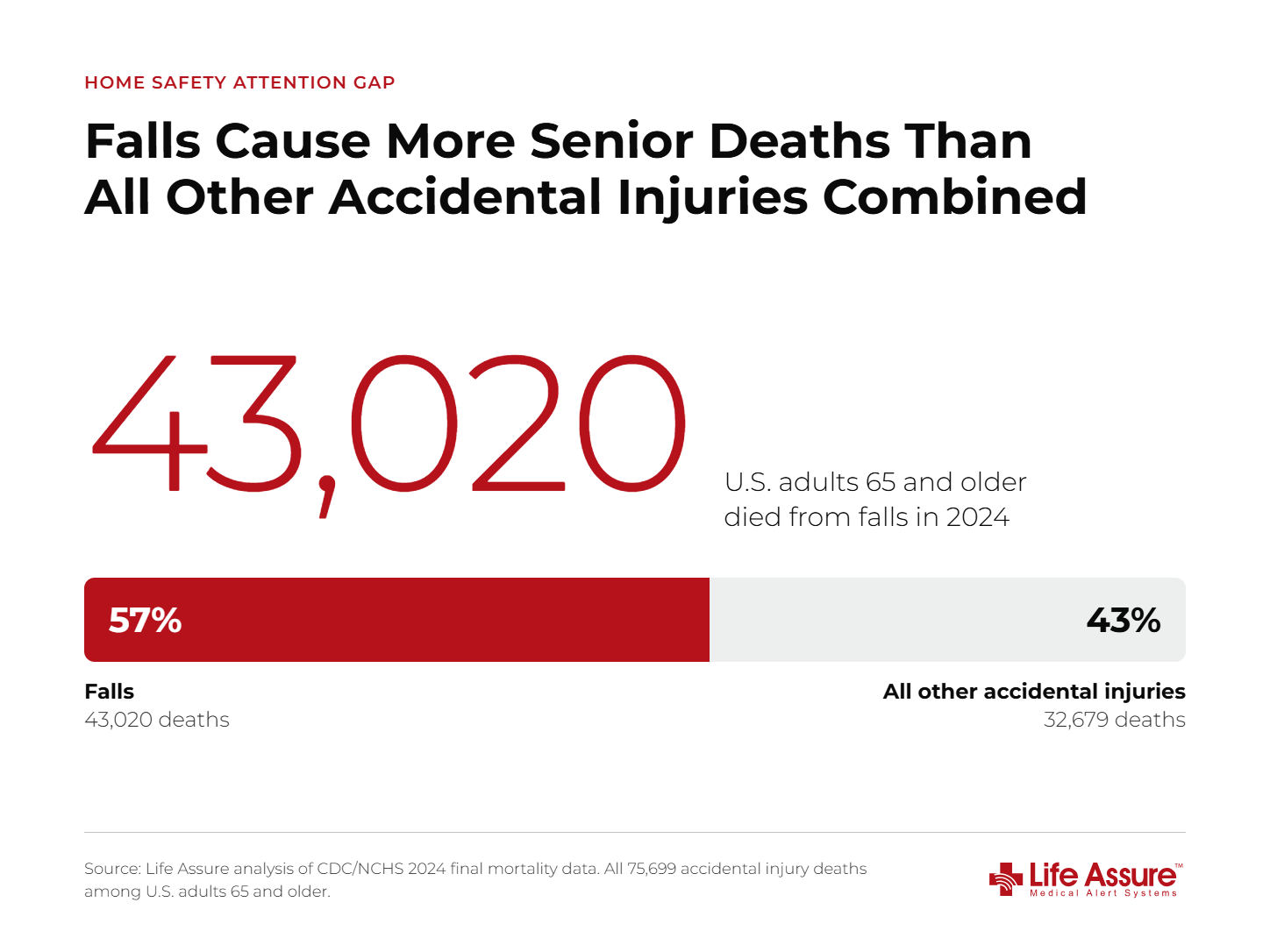
In 2024, 43,020 Americans aged 65 and older lost their lives to falls, more than to every other kind of accidental injury combined. From 2021 through 2025, 12% of the 1,560 consumer product recalls issued by the U.S. Consumer Product Safety Commission warned about a fall hazard. Fire, which accounted for 2% of those deaths, appeared in 34% of recalls.
Recall hazard statements named children, infants or toddlers 574 times in that window. They named older adults once.
The public record of product warnings describes a household with small children in it. The death records describe a household with an 80-year-old in it.
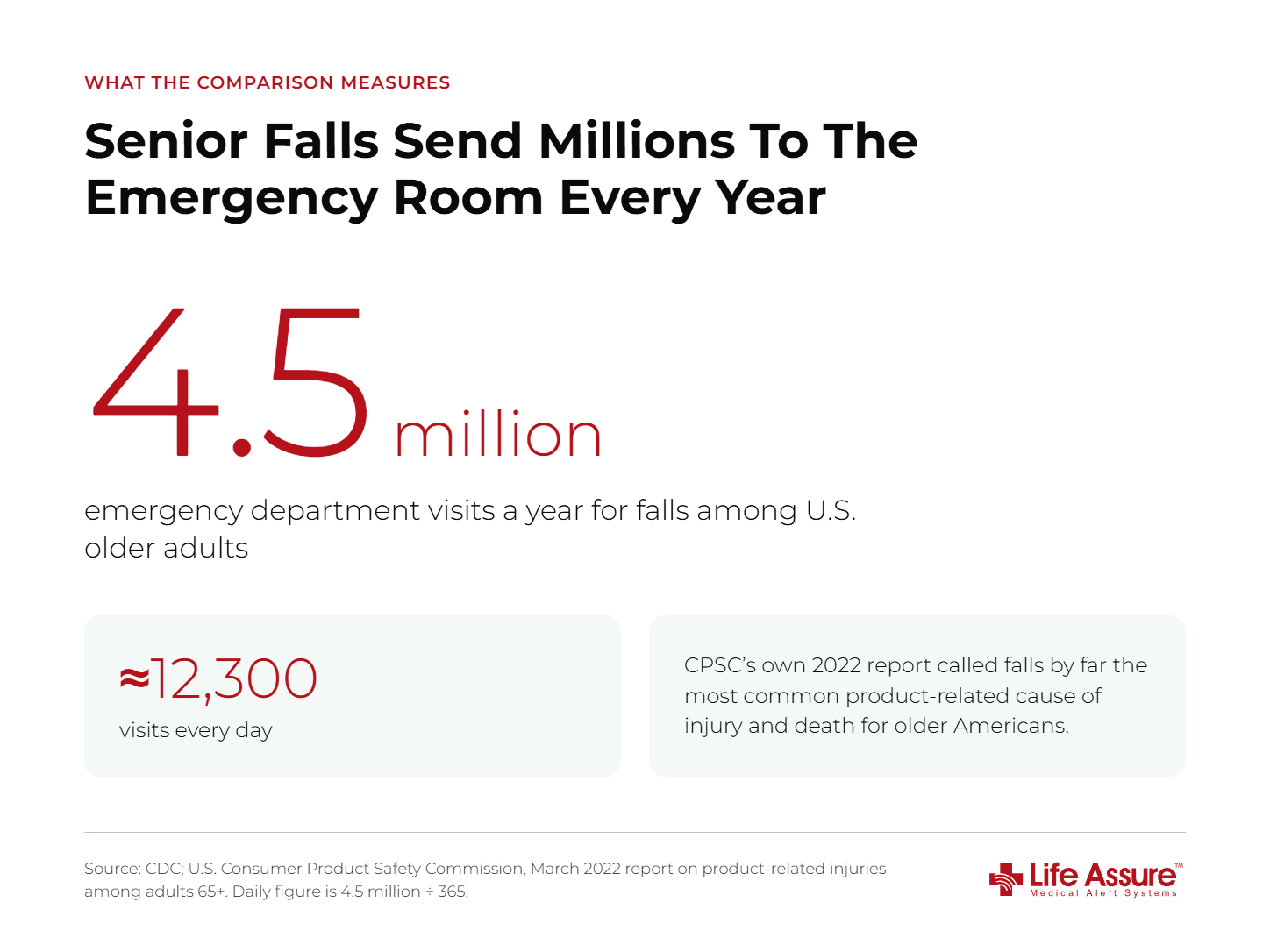
Those figures come from an analysis by Life Assure of CDC, Statistics Canada, CPSC, Health Canada and FDA data, which compared each home hazard's share of accidental deaths among adults 65 and older with its share of recall attention in both countries. The scale behind the death counts is familiar to anyone who has sat in an emergency room with an aging parent: CDC data show about 4.5 million emergency department visits a year for falls among older adults.
Key Findings
-
Falls caused 43,020 U.S. deaths among adults 65 and older in 2024, or 57% of all accidental injury deaths in that age group, and were named in 12% of CPSC recalls from 2021 to 2025
-
Fire, burns and scalds accounted for 2% of those deaths and appeared in 34% of recalls
-
In Canada, falls caused 8,118 of 11,402 senior accidental deaths (71%) and were named in 8% of Health Canada recalls
-
The Canadian senior fall death rate rose 37% from 2016 to 2024, against 17% in the U.S.
-
CPSC announced 17 adult portable bed rail recalls from 2021 through 2025, then 24 in the first ten months of 2026 Who the warnings name
Who The Warnings Name
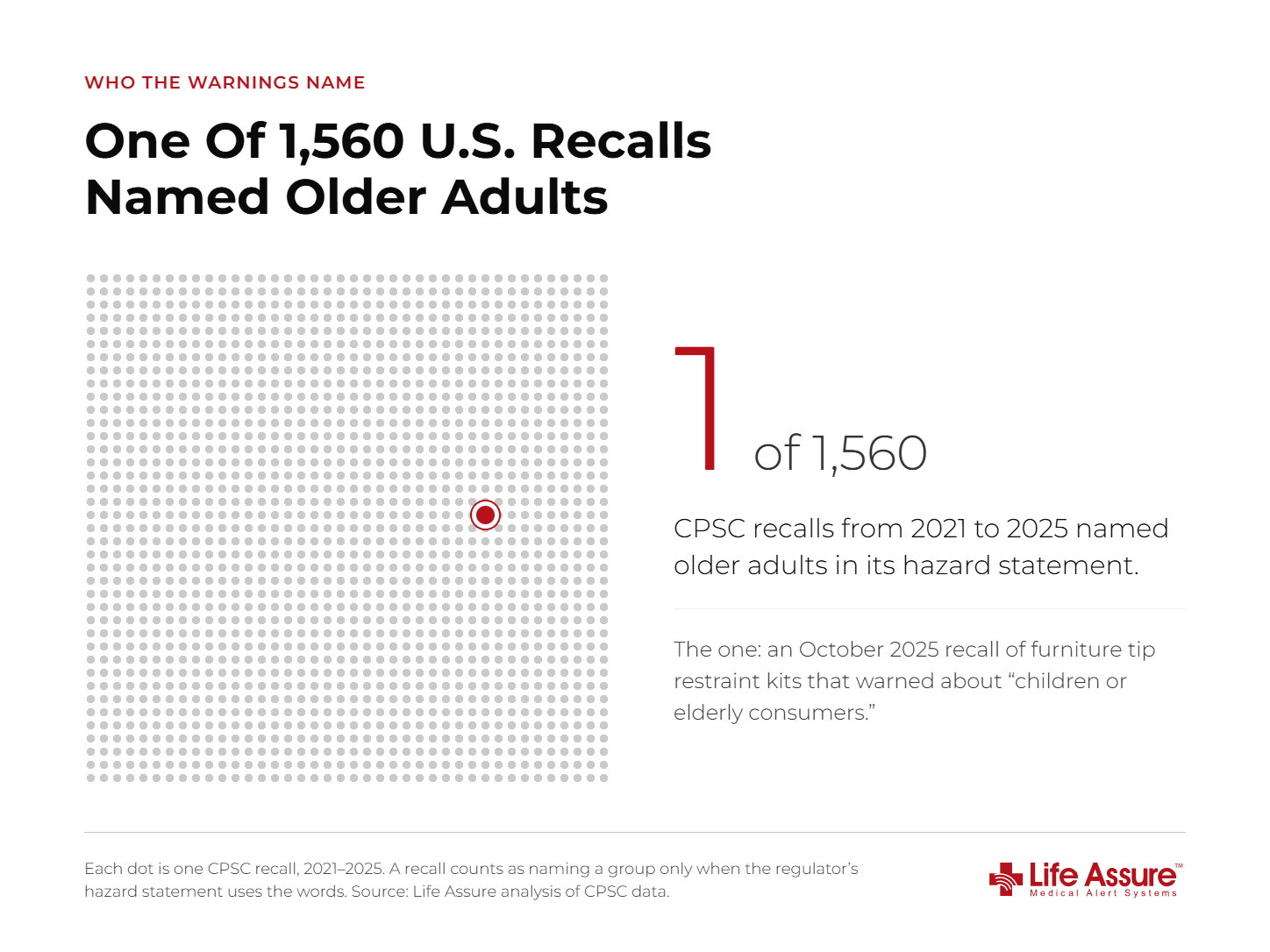
The analysis counted a recall as naming a group only when the regulator's own hazard statement used the words. By that rule, one of 1,560 U.S. recalls named older adults: an October 2025 recall of Cranach furniture tip restraint kits that warned about "children or elderly consumers."
Plenty of recalls clearly concern products older adults use, including the 17 adult portable bed rail recalls announced over the same five years, among them Medline's May 2024 recall of 1.5 million rails after two deaths. All 17 say "adult" in their warnings. None says older adults. The products are built for aging bodies. The language rarely says so.
The warnings consumers see most often are not the ones that match where older adults are losing their lives, according to Life Assure.
What The Comparison Measures
Recalls exist to pull defective products, and most of the risk of falling comes from the home itself: stairs, floors, bathrooms, the body. This study does not measure whether regulators are doing their job. It measures where public safety attention goes, and how closely that matches where older adults are actually dying.
CPSC knows the stakes. In a report released in March 2022 on product-related injuries among adults 65 and older, the agency itself called falls by far the most common product-related cause of injuries and deaths to older Americans, and its chair at the time said older adults are far more likely than other age groups to experience a significant injury or fatality from hidden hazards in their homes. One design choice matters when reading the numbers: recalls cover products made for all ages, while the death shares here cover adults 65 and older only.
The Full Index
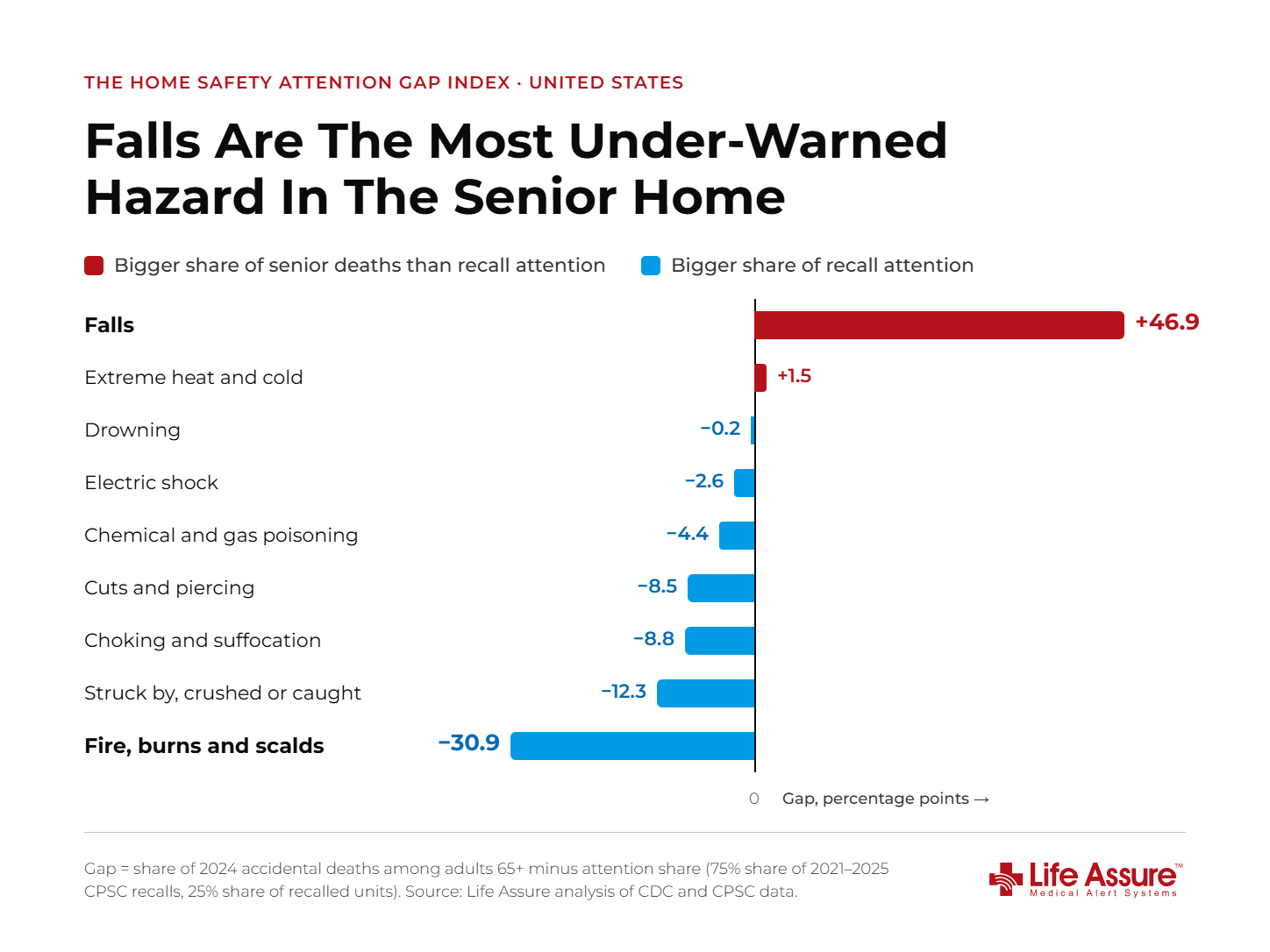
Ranked across nine comparable hazards, the pattern runs in mirror image. Falls hold a far larger share of senior deaths than recall attention, and extreme temperatures sit slightly on the same side of the line. Fire, struck-by injuries, choking and cuts all draw a larger share of recall attention than their share of senior deaths. Transport crashes and drug poisonings stay in the death totals but out of the ranking, since neither has a consumer product recall counterpart.
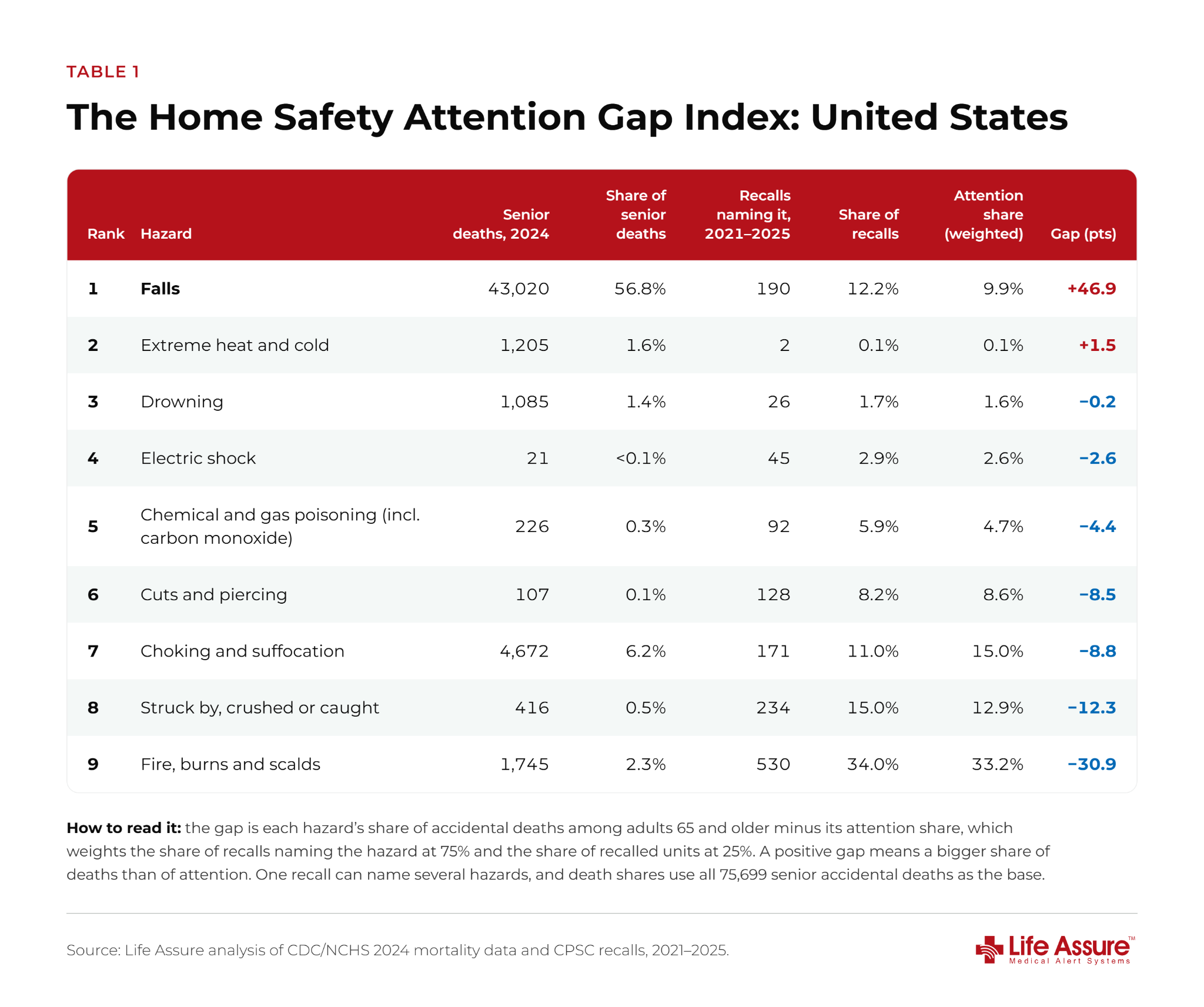
Choking shows why the index weights recall counts more heavily than units. The category includes the very asphyxiation deaths that bed rail recalls target, yet it registers as receiving more attention than its death share, partly because a single 70-million-unit candy recall dominates the unit counts. To limit that distortion, the index weights the share of recalls naming a hazard at 75% and the share of recalled units at 25%.
Table 1. The Home Safety Attention Gap Index: United States
| Rank | Hazard | Senior deaths, 2024 | Share of senior deaths | Recalls naming it, 2021-2025 | Share of recalls | Attention share (weighted) | Gap (pts) |
|---|---|---|---|---|---|---|---|
| 1 | Falls | 43,020 | 56.8% | 190 | 12.2% | 9.9% | +46.9 |
| 2 | Extreme heat and cold | 1,205 | 1.6% | 2 | 0.1% | 0.1% | +1.5 |
| 3 | Drowning | 1,085 | 1.4% | 26 | 1.7% | 1.6% | -0.2 |
| 4 | Electric shock | 21 | < 0.1% | 45 | 2.9% | 2.6% | -2.6 |
| 5 | Chemical and gas poisoning (incl. carbon monoxide) | 226 | 0.3% | 92 | 5.9% | 4.7% | -4.4 |
| 6 | Cuts and piercing | 107 | 0.1% | 128 | 8.2% | 8.6% | -8.5 |
| 7 | Choking and suffocation | 4,672 | 6.2% | 171 | 11.0% | 15.0% | -8.8 |
| 8 | Struck by, crushed or caught | 416 | 0.5% | 234 | 15.0% | 12.9% | -12.3 |
| 9 | Fire, burns and scalds | 1,745 | 2.3% | 530 | 34.0% | 33.2% | -30.9 |
How to read it: the gap is each hazard's share of accidental deaths among adults 65 and older minus its attention share, which weights the share of recalls naming the hazard at 75% and the share of recalled units at 25%. A positive gap means a bigger share of deaths than of attention. One recall can name several hazards, and death shares use all 75,699 senior accidental deaths as the base.
In Canada, The Gap Is Wider
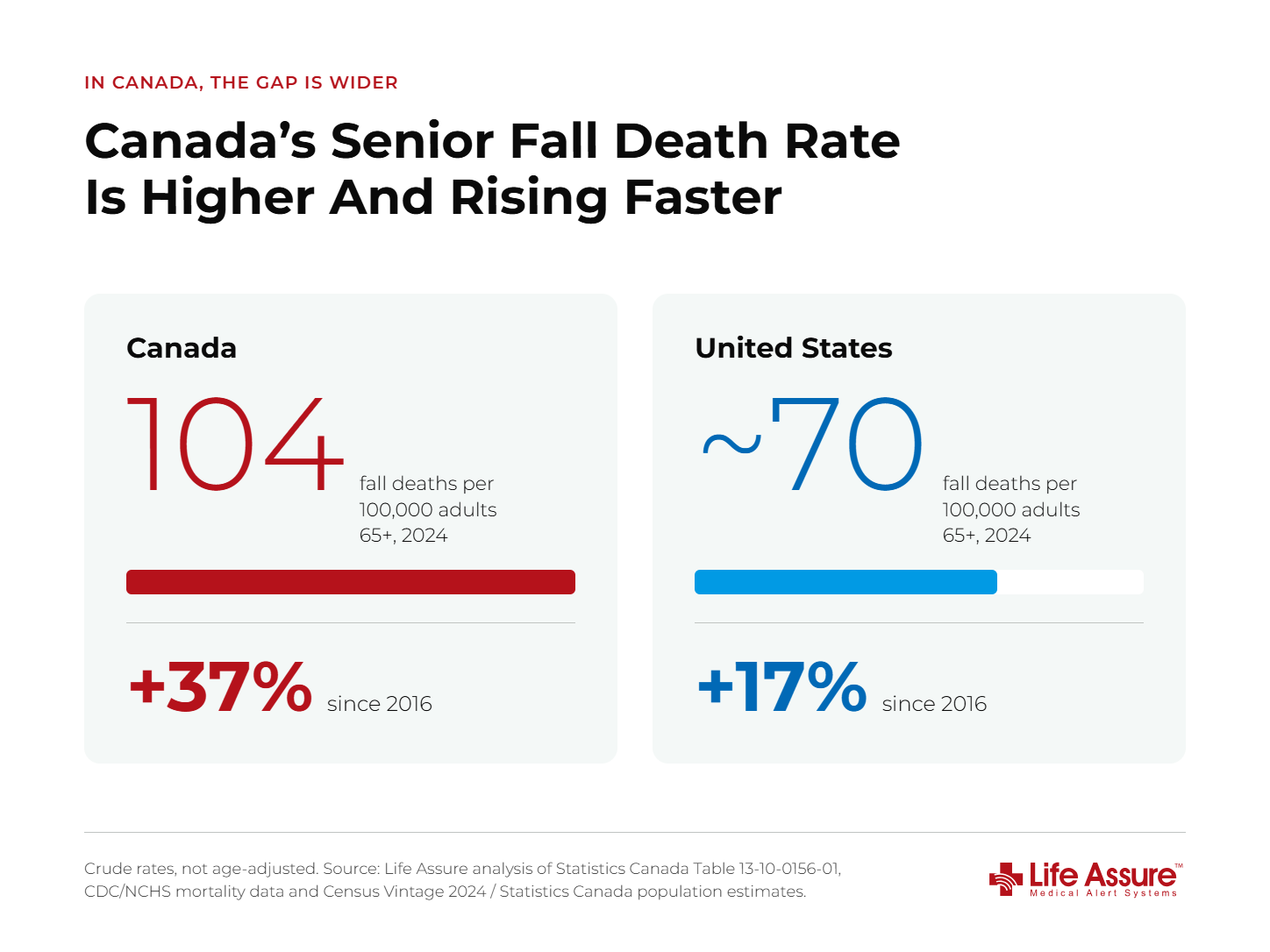
Canada runs the same pattern at a steeper angle. Falls accounted for 7 in 10 accidental injury deaths among Canadians aged 65 and older in 2024: 8,118 of 11,402. From 2021 through 2025, 8% of the 1,241 consumer product recalls published by Health Canada warned about a fall hazard. Fire, which accounted for 1% of those deaths, appeared in 28% of recalls.
The trend is moving the wrong way faster there, too. Canada's senior fall death rate reached about 104 per 100,000 adults 65 and older in 2024, against roughly 70 in the U.S., and rose 37% since 2016 compared with 17% in the U.S., though those rates are crude rather than age-adjusted. The Public Health Agency of Canada reports that falls cause 89% of injury-related hospitalizations among adults 65 and older in 2022, excluding Quebec, and cites a 2018 estimate putting the direct health care cost of those falls at C$5.6 billion a year.
Health Canada's recall notices named children 375 times in that window. They named older adults once, in a pet food recall that listed seniors among people at higher risk of illness.
The Devices Older Adults Depend On
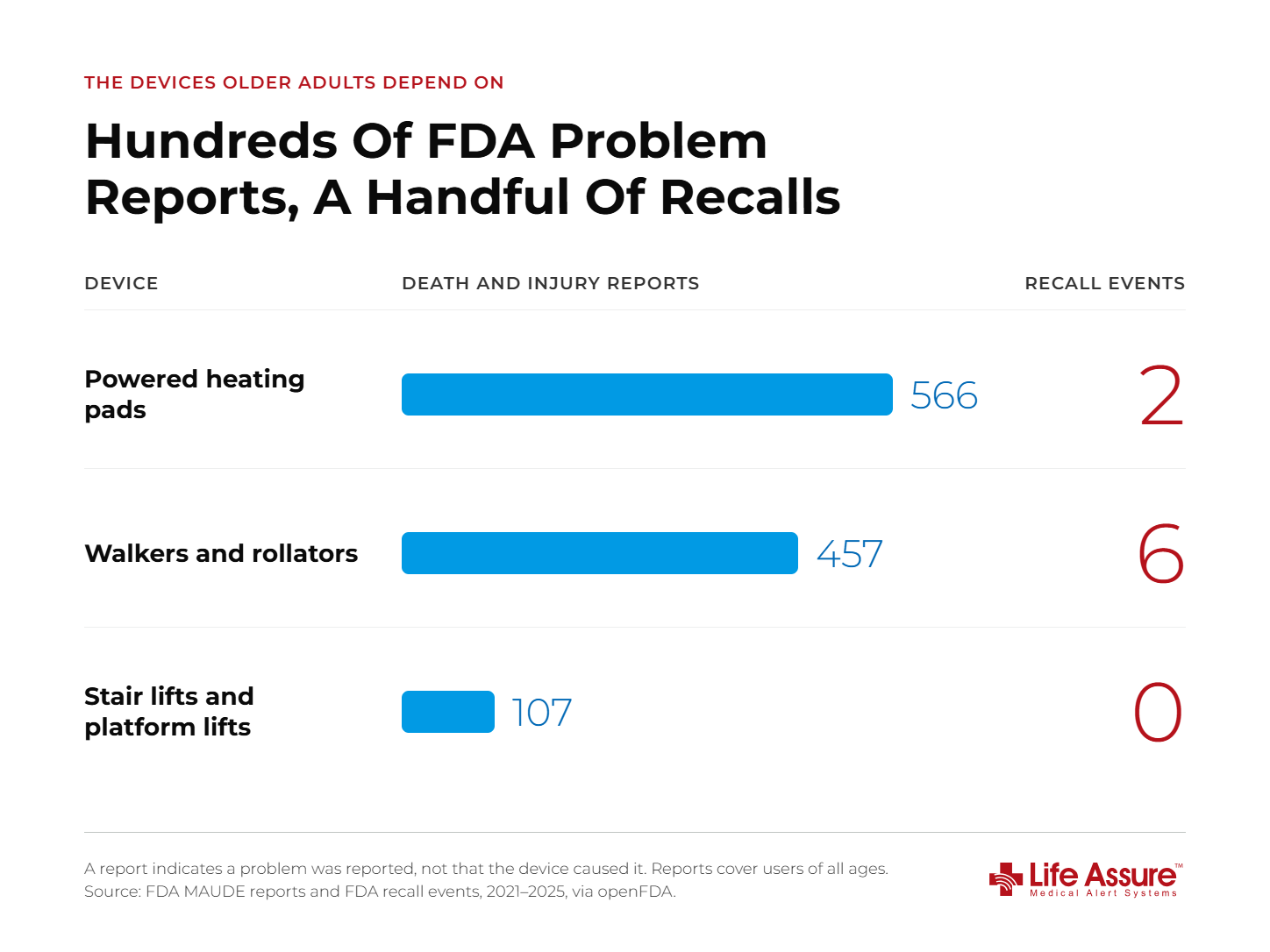
FDA problem reports tell a quieter version of the same story, with one caveat up front: a report indicates that a problem was reported, not that the device caused it. From 2021 through 2025, FDA received 566 death and injury reports involving powered heating pads, a period that saw 2 recall events for the category. Stair lifts and platform lifts drew 107 reports and no recalls at all. Walkers and rollators, the workhorses of home mobility, generated 457 reports against 6 recall events.
Signs The System Is Adjusting
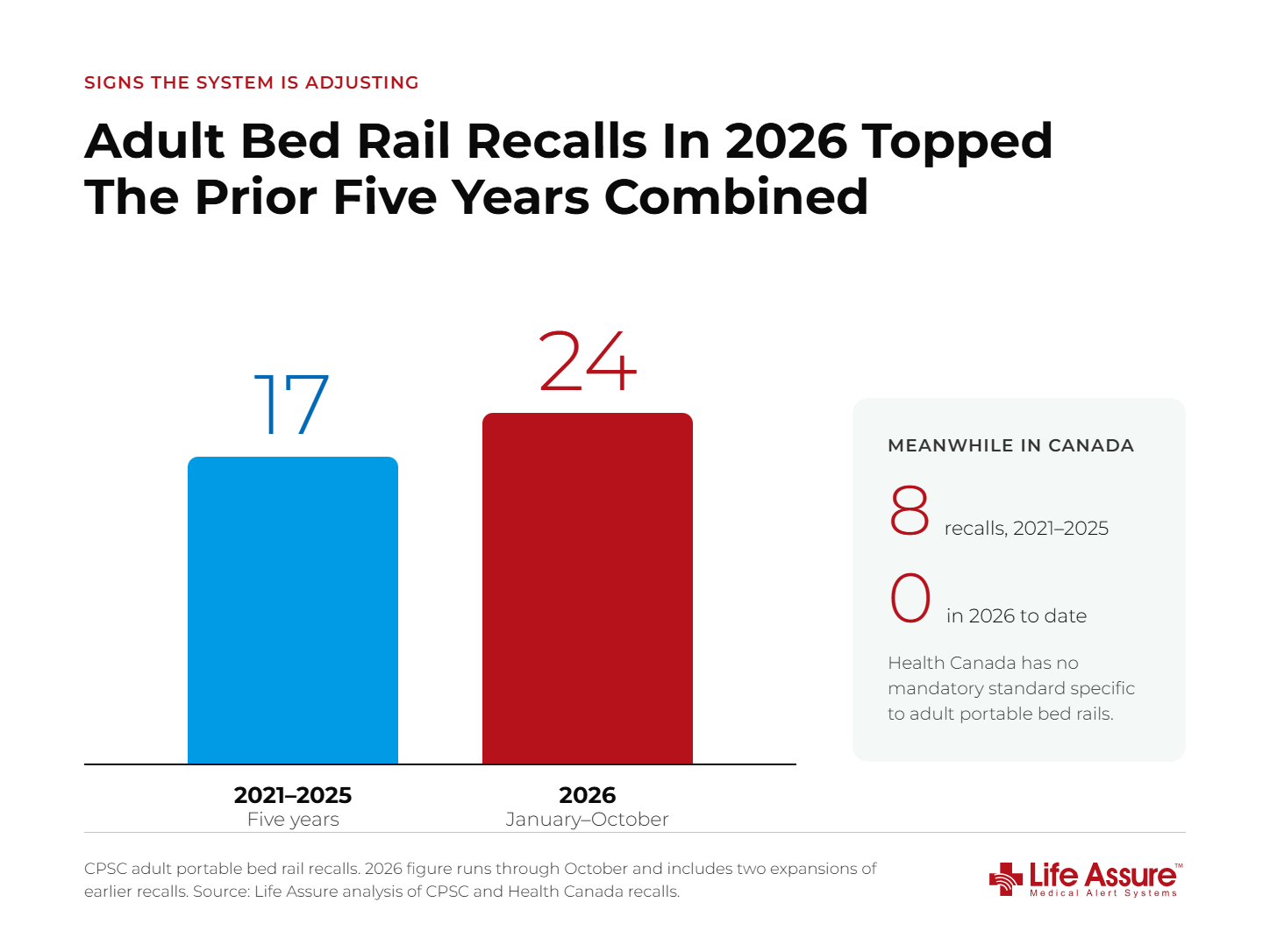
Then came 2026. In the five years from 2021 to 2025, CPSC announced 17 recalls of adult portable bed rails. In the first ten months of 2026 it announced 24, including two expansions of earlier recalls, and nearly all cite violations of the agency's mandatory safety standard for the product, which took effect in August 2023. Most of the recalled rails come from small online sellers. CPSC also issued at least two public warnings in 2026 for bed rails whose sellers declined to recall them; those are not counted here. Whether the wave reflects a broader enforcement push is a question for CPSC, and the recalls themselves don't say.
Canada announced 8 adult bed rail recalls from 2021 through 2025 and none in 2026 to date. Health Canada has no mandatory standard specific to adult portable bed rails; it regulates the products through general medical device licensing and consumer product safety rules.
The bed rail numbers suggest a recall system can catch up with a hazard. The open question the data poses is whether the next category to catch up will be the one costing the most lives.
The Takeaway
Attention is a finite resource, and for five years the public record of product warnings described curious toddlers far more often than aging homeowners. The deaths tell a different story, and the families living it already know: the most dangerous product in an older adult's home is usually the home. Reading the gap honestly is the first step toward closing it, whether that happens through recall language that names the people most at risk, standards like the bed rail rule that give enforcement teeth, or simply a generation of adult children who look at a parent's stairs the way regulators look at a crib.
Methodology
Life Assure compared each home hazard's share of accidental injury deaths among adults aged 65 and older with its share of consumer product recall attention, in the United States and Canada. U.S. deaths come from the CDC/NCHS 2024 national death records file, the most recent full year of final mortality data available, coded by underlying cause using CDC's standard injury groupings; counts match CDC's published 2024 fall figures exactly. Canadian deaths come from Statistics Canada Table 13-10-0156-01 for 2024. Recall attention covers every CPSC recall (1,560) and every Health Canada consumer product recall (1,241) first announced from 2021 through 2025, coded by the hazards named in each recall's title and hazard statement; 2026 recalls through October are reported separately. Attention share weights the share of recalls naming a hazard at 75% and the share of recalled units at 25%, because a single very large recall can dominate unit counts. Recalls cover products for all ages; death shares cover adults 65 and older only. Transport, drug and alcohol poisoning, firearm and unspecified-cause deaths remain in the death totals but are not ranked because they have no consumer product recall counterpart. In 2024, 3,541 U.S. senior injury deaths had an unspecified cause, many likely falls, so the falls figures are conservative. Hazards with fewer than 20 deaths in a country are shown but not ranked. Canadian hazard labels differ from CPSC's, so cross-country comparisons describe the pattern rather than exact decimals. Device figures use FDA MAUDE reports and FDA recall events for 2021 through 2025, via openFDA; reports indicate a problem was reported, not that a device caused it, and cover users of all ages. Death rates per 100,000 use Census Vintage 2024 and Statistics Canada July 1 population estimates and are not age-standardized. Full method and validation checks available on request.Fair Use Policy
Users are welcome to utilize the insights and findings from this study for noncommercial purposes, such as academic research, educational presentations, and personal reference. When referencing or citing this article, please ensure proper attribution to maintain the integrity of the research. Direct linking to this article is permissible, and access to the original source of information is encouraged. For commercial use or publication purposes, including but not limited to media outlets, websites, and promotional materials, please contact the authors for permission and licensing details. We appreciate your respect for intellectual property rights and adherence to ethical citation practices. Thank you for your interest in our research.About The Author





 Get Help With The Push Of A Button