

14 Balance Exercises For Seniors To Prevent Falls
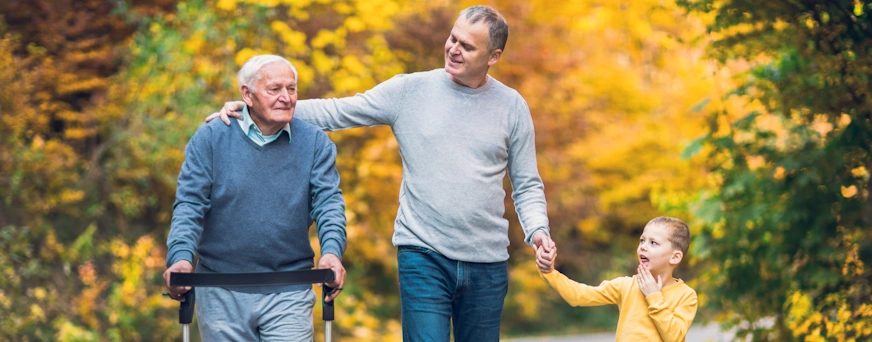
Walking difficulties and trouble getting up, or needing to rely on a cane, walker, couch, or chair handles, are clear signs of poor balance in old age. But as we cross the 60s threshold, our body starts to lose strength, which leads to improper balance during movement. Therefore, we need to take extra measures and practice exercises that make all of our movements safe and prevent falls. As the incidence of falls among Canadians is growing and the number of fatalities is increasing, the safety of older adults has become non-negotiable. The Centers for Disease Control and Prevention (CDC) estimate that over one in four older adults (age 65 or older) fall each year and that 3 million older adults are hospitalized for injuries that occur due to accidental falls rooted in improper balance. So, practice these balance exercises for seniors to move easily, feel safe with each move, and enjoy their regular activities.
Key Takeaway
Balance exercises for seniors are an effective way to ensure that seniors don't accidentally fall and incur potentially fatal injuries.
- Good body balance is correlated to physical coordination, flexibility, and posture.
- Body balance tests measure the state you are in, and then exercises are modified for you.
- Following safety practices during a workout session is a must.

Life Assure Product Quiz
Take our 30 second quiz and discover which Life Assure medical alert device is the right fit for you or a loved one.

Life Assure Product Quiz
Take our 30 second quiz and discover which Life Assure medical alert device is the right fit for you or a loved one.

Importance of maintaining balance for older people
Studies show that a firm, stable, and balanced walking stride can improve your speed and effectiveness. The stiffer the person walks (63-88 steps per min), the greater the tenacity and the lower the risk of falls, as opposed to walking at a slower pace, around 29 steps per min.
Prevents accidental slips and falls
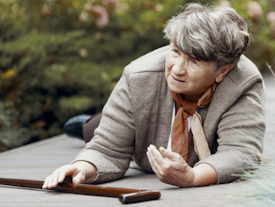
With age, the senses become less acute, muscles weaken, and reflexes slow. This progressive loss can make people more prone to falling and is a primary cause of fractures, broken bones, and joint injuries in older individuals.
Increases Physical Stability and Control
To develop physical skills, such as coordination and movement, good balance is necessary. Certain exercises for seniors are useful in enhancing hand and leg coordination, hand to eye, legs to eye, joint positioning, and core muscle stability. As a result, when stability is increased, older adults perform basic activities smoothly, which are needed for daily living, such as walking comfortably in tricky areas like bathrooms, household chores, climbing stairs, and getting up from a chair or couch without falling.
Supports Mental Health and Self-Sufficiency
Elderly people are not only at risk of falling, but also tend to become more panicked or anxious, leading to the fear of falling, particularly when they don't feel they are confident enough in some places. These include stairs, bathrooms, and rocky surfaces. By practicing balance exercises, confidence will come back, and everyday life will be enjoyable.
Balance assessment methods for seniors
Indeed, with age, body balance declines, but not necessarily all 60 or 65 year olds have the same capability. Before recommending proper balance exercises, physical therapists conduct some tests to properly understand the older adult’s stability and potential risk of falling.
Berg Balance Scale
This balance assessment method offers a reliable and straightforward mechanism to measure the ability of older adults to remain steady even during common, regular activities. In the test, 14 tasks are given to perform that examine the aspect of balance. These tasks include getting up from sitting to standing, standing without any support, reaching upward or forward without stretching one's arm, retrieving something from the floor, turning back over the shoulder, properly completing a complete circular turnaround, keeping one leg on a stair or stool, standing with one leg in front of another, and simply standing with the support of one leg. Each activity gives significant information about older adults’ postural control, internal balance system, and adaptability of the body to changing direction. These tasks are assessed on a scale of 0 to 4, with 0 indicating that the person couldn't do the task at all and 4 indicating that the person feels confident and can do the task independently.
Timed Up and Go Test
It is one of the most trusted and effective balance assessments for seniors. In this test, physical therapists time the senior's movement sequence. The test begins with an older individual seated on a standard chair, followed by standing, walking normally for 3 meters, then turning around, walking back to the chair, and sitting down. If the activity is completed within 12 seconds or less, then most likely you are in the safe zone; otherwise, you are not.
Four Square Step Test
This is another balance assessment mechanism but a bit more complicated than the TUG. Thus, four squares are marked on the ground, and the person starts from one end of the square and is timed as he takes a step to the other three squares clockwise and then anti clockwise without touching the lines passing through the squares. All these movements will evaluate the multidirectional footwork, particularly the ability to change speed and direction suddenly on uneven ground. If you take more than 15 seconds to complete the whole pattern, then you have poor balance.

14 Balance Exercises for Seniors to Prevent Falls
These easy balance exercises for seniors can be performed at home and will also help to enhance your mobility, ensuring you stay steady on your feet and independent. This can increase your self esteem, help maintain your health as you get older, and lower the chance of falling.
1. Sideways Walking
This exercise improves side to side balance, strengthens crucial hip muscles, and lowers the risk of falls.
- Stand comfortably upright with your feet together.
- Keep your knees slightly bent to a comfortable level without putting extra strain on them.
- Slowly step sideways in a controlled manner, moving one leg to the side.
- Bring the other leg sideways to follow, returning to a comfortable stance.
- Keep your hips level while moving. Take 10 sideways steps in each direction across the room.
2. Simple grapevine
It is also like sideways walking, but here you have to position your legs in a crosswise position.
- Stand straight with your feet together, then cross your right foot over your left foot.
- Bring your left foot back to the starting position.
- Repeat the movement for 5 cross steps on each side.
- If you feel uncomfortable while doing this exercise, use a wall for support and stability.
- Take small steps and move slowly, focusing on maintaining your balance.
3. Heel-to-toe walk
It is also called tandem walking, one of the most effective exercises for seniors that helps improve their balance by narrowing the support base and stabilizing their body with every step.
- Stand straight and place your right foot just in front of your left foot, with the right heel close to the left toes.
- Repeat the same movement with your left foot in front of your right foot.
- Keep looking straight ahead while performing the exercise.
- If you need support, place your hand on a wall for stability.
- Perform at least 5 steps. As you become more confident, gradually reduce your reliance on the wall for support.
4. One-leg stand
This is one of the crucial balance exercises for seniors, as it not only focuses on improving external body balance but also internal balance, such as eye coordination with hands, legs, and other body parts.
- Stand upright on a flat surface, facing a wall.
- Stand about an arm's length away from the wall and stretch both arms forward.
- Place your fingertips against the wall for support.
- Slowly lift your left leg to hip level.
- While holding this position, slightly bend your standing leg.
- Slowly lower your lifted leg back to the floor.
- Repeat the exercise 3 times with each leg, holding the raised position for 5 to 10 seconds each time.
5. Step-up
As seniors face most issues while climbing stairs or stepping onto a stool, this exercise will help to ease that and reduce fall risks.
- Stand upright in front of a staircase in your home.
- Slowly lift your right leg and step onto the first stair, using the handrail for support.
- While maintaining your balance, bring your left leg up beside your right leg.
- Slowly step back down onto the floor and return to the starting position.
- Repeat the exercise 5 times with each leg, using the handrail for support as needed.
6. Shoulder rolls
It ranks as one of the simplest but crucial exercises for seniors aiming to improve body balance. As body balance depends on better flexibility and strength, shoulder rolls lay the foundation of your workout routine.
- Start in a comfortable seated or standing position.
- Slowly roll your shoulders upward and then downward.
- Repeat the same movement by rolling your shoulders forward and backward.
- Repeat the exercise 5 times per session.
7. Balancing Wand
You need a chair and a cane or broomstick to perform this balancing and coordination exercise.
- Place a cane or stick upright on the floor and hold it with your left hand.
- Try to keep the stick upright for as long as possible without changing its position.
- Repeat the exercise with your right hand.
- This exercise helps improve balance and coordination on both sides of your body.
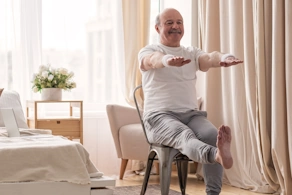
8. Marching in Place
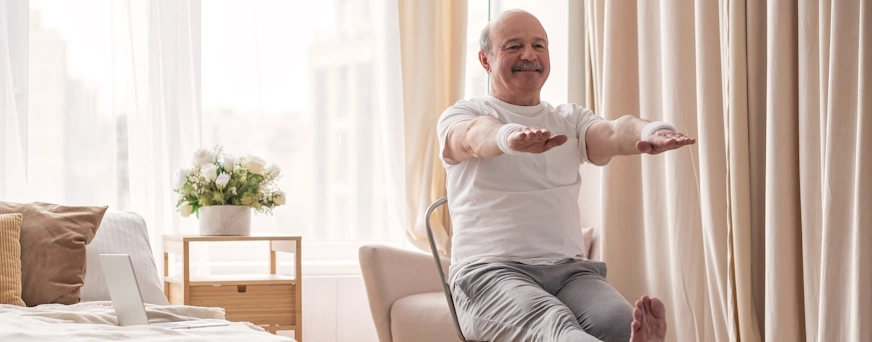
It is one of the seated balance exercises that work on your hip, lower back, and quad muscles.
- Stand with support from a walker, or sit comfortably on a chair.
- Slowly lift your left knee as high as is comfortable.
- Slowly lower your left leg and repeat the same movement with your right knee.
- Alternate between both legs for a total of 20 repetitions. If you feel tired, take a short break before continuing.
9. Clock Reach
This exercise helps to improve your dynamic balance, single leg stability, and also prevent accidental falls, preparing the body to perform flexibly in multidirectional movements.
- Place a chair in front of you and stand behind it.
- Imagine that you are standing in the middle of a large clock, with 12 directly in front of you and 6 directly behind you.
- Hold the back of the chair with your left hand for support.
- Lift your right foot slightly and extend your right arm forward, pointing toward 12 on the clock.
- Move your right arm to the side, pointing toward 3 on the clock.
- Then move your arm backward, pointing toward 6.
- Bring your arm back to 3, then return it to the 12 position.
- Keep looking straight ahead throughout the exercise.
- Repeat the exercise 2 times on each side, using the chair for support as needed.
10. Rock the Boat
This exercise is important to strengthen your quads, core, and hip muscles, and this trio plays an important role in your body balance.
- Stand upright and slowly spread your feet hip-width apart.
- Extend your arms out to the sides for balance, or place your hands on your hips.
- Lift your left foot off the floor and bend your knee, bringing your ankle toward your buttocks.
- Hold this position for about 30 seconds, or release it sooner if you feel any discomfort.
- Slowly lower your left foot and repeat the exercise with your right leg.
- Repeat the exercise 3 times with each leg, using support if needed to maintain your balance.
11. Tree Pose
One of the iconic and toughest balancing workouts for older adults.
- Stand upright and slowly shift your body weight onto your right leg.
- Lift your left leg and place your left foot against your right shin, ankle, or thigh.
- Avoid placing your foot directly against your knee.
- Keep your hands in a comfortable position, either raised in front of you or resting on your hips.
- Hold this position for up to 1 minute, or stop sooner if you feel any discomfort. Use support if needed to maintain your balance.
12. Single foot balance
It improves the calves and hip muscles for better balance and mobility.
- This exercise is similar to knee raises, but it is performed on a balance board.
- Stand with your right foot positioned in the center of the balance board, using support if needed.
- Slowly lift your left foot and knee upward as high as is comfortable.
- Hold this position for 30 seconds, or stop sooner if you feel any discomfort.
- Carefully return to the starting position and repeat the exercise with the other leg.
- Repeat the exercise 2 to 3 times on each side.
13. Single Limb Stance with Arm
This balance exercise is effective if you focus on your physical coordination.
- Stand upright with your feet together, facing forward, and keep your arms at your sides.
- Slowly raise your left arm above your head.
- While holding this position, lift your left foot off the floor.
- Hold this position for about 10 seconds, or stop sooner if you feel uncomfortable.
- Return to the starting position and repeat the exercise on the other side.
14. Forward and backward tilt
It is a standing weight shift exercise that is mostly performed over a balance board. This exercise improves posture, stabilizes the core, and prevents falls.
- Place your feet on opposite ends of the balance board, with one foot in front and the other behind you.
- Slowly shift your body weight forward until the front of the balance board touches the floor.
- Hold this position for a few seconds.
- Then slowly shift your body weight backward until the back of the balance board touches the floor.
- Hold this position for a few seconds.
- Repeat the exercise a few times, according to your comfort level, using support if needed.
15-min Balance exercise routine for Seniors
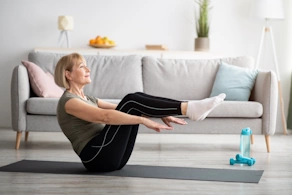
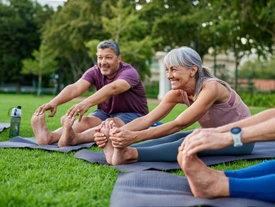
To improve movement and strengthen muscles, bones, and joints, most importantly avoiding accidental slips, do these 15 minute balance exercises for seniors on a daily basis.
Warm up (1 minute)
Stretch neck, hands, and legs standing or sitting before starting your exercise.
Seating exercises (3 minutes)
Finish all the seated exercises within 3 minutes, such as Balancing Wand, shoulder rolls, and marching in place. If you experience pain, stop immediately.
Standing Exercises (9 minutes)
These exercises are the most crucial ones, which involve coordination, core body balance, and flexibility. Perform all exercises: simple grapevine, heel to toe walk, rock the boat, tree pose, single foot balance, single limb stance with arm, and forward and backward tilt.
Rest (1minute)
After 15 minutes, sit comfortably on the chair and take short, deep, relaxing breaths. Then drink plenty of water and resume your daily activity.
Key Progression Levels of Balance Exercises for Seniors
While all of the balance exercises for seniors are clinically effective, you may not be suited for them all. So, gradually build up the intensity of the exercises based on your comfort level.
Primary Level
As a beginner, perform simple standing exercises like grape vine, shoulder rolls, or walking laterally. Taking assistance from a chair or wall is most advised.
Intermediate Level
Once you become comfortable with the methods and intensity, slowly shift into moderate level exercises such as heel to toe, step up, one leg stand, increasing repetitions and sets.
Advanced Level
When you have been practicing these exercises for months and have significantly improved your balance, now it's time that you level up your workout session. In the aforementioned exercises, there are certain tricky moves that need precise balance, such as tree pose or single limb stance, which come under this level. Besides, you can also increase the repetitions and sets for other exercise whcih improves your pace.
Safety measures for seniors while doing balance exercises
Follow these safety tips while practicing the balance exercises for seniors.
- Use a sturdy chair for support while performing the exercises.
- Always wear comfortable, flexible shoes while exercising, even at home. Avoid exercising barefoot.
- Wear lightweight, comfortable, and moderately loose clothing.
- Even during a 15-minute workout session, take short breaks and sit down for a few seconds when needed to avoid unnecessary physical strain.
- Do not start a new exercise routine on your own. Follow exercises prescribed by an experienced physical therapist.
Losing body balance is a common problem among older people. Their movements become uncontrolled and wobbly, making them more prone to accidental slips. Not only this, but they also develop a sense of fear of falling even though they are standing or sitting in a secure place. Therefore, the above mentioned balance exercises for seniors will help them to regain lost balance and strength. While practicing these exercises, make some minor adjustments to the number of repetitions and sets as per your comfort.
References:
1. https://www.uclahealth.org/news/article/why-balance-so-important-and-how-improve-it
2. https://www.mainehealth.org/healthy-communities/prevention-and-wellness/fall-prevention-matter-balance
3. https://meloqdevices.com/blogs/meloq-updates/balance-assessment-tests-for-elderly
4. https://www.healthline.com/health/exercise-fitness/balance-exercises-for-seniors#tai-chi-exercises
5. https://www.nhs.uk/live-well/exercise/balance-exercises/
Disclaimer:
This content is for informational purposes only and does not substitute for professional medical advice. Always consult a doctor or physical therapist before starting these exercises. Use a steady chair or wall for support, wear proper shoes, and stop immediately if you experience pain, dizziness, or discomfort.

 Get Help With The Push Of A Button