


Complete Guide to Aging in Place in Canada
It is common for people who have spent over 60 years of their lives in a place to want to stay there till the end of time. More than 75% of older adults plan to do just this. You can even get financial assistance from the government for multiple purposes that make aging at home easier.
Over the past 20 years, the interest in aging in place has increased steadily. The search intent for older adults’ home care is also increasing day by day.
This is because baby boomers think that they require full assistance to stay safe, healthy, and connected in their respective homes, without moving to senior living homes or communities.
Not only financial assistance, but also technological advancements and caregiving facilities at home benefit seniors.
Key Takeaways
Aging in place is the new big thing for Canadian seniors
- Government financial assistance has made it easy for seniors to live comfortably in their home.
- There are several caregiving facilities that you can avail as per your needs.
- Technological advancements have also been highly beneficial for seniors to reside at home comfortably.

Life Assure Product Quiz
Take our 30 second quiz and discover which Life Assure medical alert device is the right fit for you or a loved one.


Life Assure Product Quiz
Take our 30 second quiz and discover which Life Assure medical alert device is the right fit for you or a loved one.

What is Aging in Place?
The simple meaning of aging in place is that a person continues to live in their own established home and community as they grow older.
The reason this concept has taken a major turn is that people, when they get older, are often shifted to welfare facilities or assisted living facilities under intense medical supervision. Although it sounds simple, not everyone wants to spend their later years in another place other than at home.
Choose Between Aging in Place and Assisted Living with Confidence
Ageing in place or shifting to a care facility is a common discussion seen among Canadian seniors and their family members.
Aging in Place
Living in your own place not only offers mental peace, but also better physical health outcomes such as fewer hospitalizations and better functional ability.
The reason is simple: when people are at home, they are more familiar with the place, which makes them less likely to fall. Accidental falls are the primary health concern for older adults, causing around 1 million hospitalizations yearly
Furthermore, when seniors stay in their own place, they do not feel as stressed and anxious as compared to moving into a new place. Naturally, lower stress means a minimized risk of heart conditions.
In addition to this, at home, the estimated total expenses range between $900 and $3,500 every month, which includes utilities, groceries, household essentials, home maintenance, home care support, and a medical alert system.
Although the costs seem manageable, with increasing care needs, expenses can escalate quickly. But with government financial assistance, aging in place would not be as difficult as it may seem.
Assisted Living in a Care Facility
On the contrary, the monthly cost for assisted living is around $4,000–$7,000. Here, you will benefit from dedicated caregivers offering structured support whenever you need it. As you will be surrounded by other community members, it will also increase your social interaction.
But here you may not find personal privacy more often, and all services may not be included in your assisted living monthly package; rather, they are add-ons, so you need to pay extra. This creates financial pressure even with government aided programs.
Therefore, it can be concluded that although welfare communities or assisted living offer opportunities, aging in place offers more benefits in terms of care and financial support.
Financial Planning for Seniors to Support Aging in Place
Understanding financial assistance options available for elderly people living in Canada can help retirees and their families to plan better for housing, care, and everyday expenses in later life.
There are some federal and provincial financial assistance programs that can help seniors to live in their own place more comfortably. In this guide to aging in place, key schemes and programs are explained that fit right into your retirement plan.

Federal Financial Programs
Canadian government has initiated several programs aiming to provide regular income to older adults. These benefits work as the financial backbone of seniors, helping cover daily living expenses.
Old Age Security (OAS)
It is a pension scheme that benefits Canadian residents and legal citizens who are above 65 years old. This benefit scheme is based on the residential history of seniors in Canada, not employment history, and helps to offer a basic income source after retirement.
Guaranteed Income Supplement (GIS)
The Canadian government has come up with another benefit scheme for OAS pension holders with a low income background. The Guaranteed Income Supplement (GIS) scheme provides them with the opportunity for additional monthly payments without any taxation.
This saves up a notable percentage of their annual expenses. So now seniors with limited savings can make regular expenses manageable.
Both GIS and OAS can help seniors directly with their daily expenses such as housing, food, and other activities.
Allowance and Allowance for the Survivor
If any senior is between 60 and 64 years old with low income and is also the spouse or partner of a GIS beneficiary, they will be qualified for this scheme after their partner or spouse’s demise. This program provides important income support before you become eligible for OAS and GIS.
Provincial and Territorial Support Programs
These programs are an extension of federal financial plans. Each province in Canada has come up with new financial assistance programs that ease the cost of living for a senior.
These programs vary by location, so it is important to know what type of plans and programs are available in your current residing zone.
Alberta
Alberta Seniors Benefit is a government program that offers financial support to seniors. By enrolling in this program, you will receive a monthly stipend based on marital status, accommodation, and income.
Alberta Blue Cross for Extended Health benefits seniors is a scheme covering dental care, optical care support, and other health related services. Eligibility is based on your income and age.
Not only health benefits, the Senior Home Adaptation and Repair Program offers low interest home equity loans to help older people pay for their home maintenance, repair, and even renovation fees. All these make aging in place much easier and more comfortable.
Ontario
Elderly people living in Ontario can gain benefits such as property tax relief and several assistance programs that help them stay in their own residence comfortably.
Ontario Health at Home coordinates with supportive housing and home care services for eligible seniors, reducing their need for expensive care settings.
There are additional provincial programs which include the Guaranteed Annual Income System, the Ontario Drug Benefit, and the Ontario Seniors Dental Care Program, easing the financial burden of aging.
British Columbia
To get support for housing affordability and everyday living expenses, there are several programs for seniors living in British Columbia.
Enrolling in the Shelter Aid for Elderly Renters (SAFER) program will provide you with financial assistance if you pay more than 30% of your income for rent. The amount for assistance varies as per individual seniors’ income and rental expenses, but overall it minimizes financial strain for lower income renters.
Apart from that, there is a Property Tax Deferment Program, which gives permission to seniors to pay later for their annual property taxes as per convenience.
The government also administers the BC Rebate for Accessible Home Adaptations program, which supports home renovations that improve safety and accessibility.
Thus, the collaborative approach of both federal and provincial programs helps older adults to manage their regular living expenses and plan for the future comfortably, making ageing in place a fine option.
Technologies Supporting Seniors to Stay in Place
As Canadian older adults prefer staying at home instead of moving into a caregiving facility, they need a proper strategy to live independently that supports their overall well being, such as cognitive health, improvement in regular activities of daily living, mobility, physical health, safety, and socialization.
Now, with the advancement of new technologies, aging in place has become easier than ever. These gadgets and mechanisms do not involve high tech assistance; rather, you can use them easily at your own convenience.
Smartphones and Tablets
With the increasing involvement of technology in our lives, smartphone and tablet usage has become common even among older adults.
Although the convenience and assistance of these smart devices change over time, their features remain easy even after updating to newer versions of applications and phone interfaces. There are some common ways in which smartphones and tablets support elderly people, including:
- Assistive Technology: These include dictation, text-to-speech features, and visual support, which are easily available in every smartphone and help seniors with hearing or vision problems.
- Cognitive Engagement: It is one of the most important elements when talking about improving the brain health of seniors. You can download several games that work as brain teasers like crossword puzzles, jigsaw puzzles, and Sudoku, helping to improve your memory, problem solving skills, and maintain overall cognitive health.
- AI Voice Assistants: They are common in most smartphones and allow hands free communication like texting, emailing, or calling someone. It is highly effective for elderly people with difficulty in mobility or cognitive decline. Video or voice calling also helps you to socialize more often in the comfort of your own place.
- Inbuilt Reminder Application: This helps in keeping track of taking medications, drinking water, and fixing or attending appointments.
Smart Home Systems
Smartphones are not the only tech driver in your life right now; rather, your whole living space could be a tech hub. With smart technologies, you can easily maneuver simple daily activities such as switching on and off lights, temperatures, and even doorbells.
For this, install a thermostat in your home that will keep the temperature under control, and smart technologies that will answer your main door.
Seniors and their caregivers can operate these smart home systems easily to manage all household activities, ensuring comfortable and safe surroundings all the time.
There are also specific smart technologies that can translate basic household sounds such as doorbells, kitchen timers, reminders, or phone rings into physical sensations for those who have hearing impairments.

Remote Health Monitoring
Aging in place is successful when your health is properly monitored. As people age, daily doctor or hospital visits for basic checkups do not always become possible. So, start using wearable devices that help to keep track of your health and fitness.
These devices help monitor your heart rate, oxygen level, calorie intake, and the steps you have completed on a daily basis. It becomes easier for your healthcare provider to track all these data and design a proper treatment plan if required.
These individualized healthcare mechanisms are highly beneficial to manage chronic conditions in seniors.

Medication Management Systems
To know how to age in place comfortably, keeping tabs on your medications is always a priority. Mobile reminders for medications indeed are your first choice, but they remain relevant if you take 2 or 3 medications per day.
But what if you take around 10 different medicines at multiple times and you do not know which medicine needs to be taken when? It becomes pretty hard to track. Several health care reports have stated that a notable percentage of adults between 60 and 79 years of age take more than 5 or more prescription drugs.
Therefore, using automated medication dispensers is viable, as they send notifications to your phone when it is time to take your medicine. These machines also dispense the medication to ensure you do not miss the dosage.
Sensor Technology
Innovative technologies now use sensors in the living space to collect data about the person who stays there. After this, they exchange data with other sensors and map out your complete daily routine over the internet and assist you in every task.
These technologies can track physical activity and motion to sense your eating and sleeping time. You no longer need to look for the switchboard in the dark, as light sensors will sense your footsteps and switch on the light automatically, reducing accidental falls. After you leave, they even switch it off.
Also, there are sensors that actively help seniors (who are unable to speak) to call their caregivers in times of distress.
Apart from these, smart window blinds, which are remote operative, are also beneficial. Using sensor mattresses, a core health monitoring tool, can keep track of your sleeping pattern.
Along with these, smart mats and floor sensors are also useful in preventing falls, especially at night.
5 Smart Ways to Make Your Home Safer for Independent Living
After a certain age, the need to go outside minimizes, and one's own home becomes their individual sanctuary. But if your sanctuary is not well protected, it leads to occasional accidental injuries.
In this guide to aging in place, below are 5 home safety parameters that you need to follow.
Enhance Home Comfort with Senior-Friendly Furniture Choices
To build an elderly friendly home, make sure that all furniture is in a comfortable position. Therefore, avoid keeping tall or very short furniture.
Bring sofas and beds of standard height so that elderly people do not feel pain while getting up and sitting down. Even cupboards and dining tables need to be of standard height for maximum convenience.
Measuring standard height varies with furniture. For a bed, it is based on the notion that the elderly person’s feet reach the floor when seated. Besides, if your bed needs a bit more height, just put another slim mattress.
Choosing a padded headboard for seniors is good as it gives the ultimate comfort while they sleep. Not only is the height difference a goal here, but also rearrange the furniture properly so that seniors can move freely without hitting their toes or knees abruptly.
Ensure Your Home is Elderly-Friendly with Safer Flooring
Accidental slipping or tripping is very common with elderly people. As bones and muscles get weaker with age, a minor fall can turn into a major injury. So the only way is to make your floors at home resistant to slipping.
For this, installing anti slip floor tiles in the washroom would be ideal, as wet surfaces pose the main hazard for the elderly. Also, consider this for the kitchen.
In the rest of the house, you can put anti slip mats under rugs, as it will keep carpets in their own place. The thresholds between rooms should be either fully removed or lowered, as this leads to accidental tripping.
Improve Home Safety with Senior-Friendly Lighting
Accidental slipping or tripping is very common with elderly people. As bones and muscles get weaker with age, a minor fall can turn into a major injury. So the only way is to make your floors at home resistant to slipping.
One of the best ways to improve home safety and support aging in place is installing proper lights all over your home. Dark or dim light areas carry the risk of slipping, tripping, or bumping.
In addition to this, make sure your house gets as much natural light as possible. As older people spend most of their time confined, natural light is significant indoors. Setting up your bedroom with large windows or having a long balcony would be sufficient.
If you want to renovate now, you can easily do so with the help of Canadian financial assistance programs.
Make Your Bathroom Elderly-Friendly with Essential Safety Features
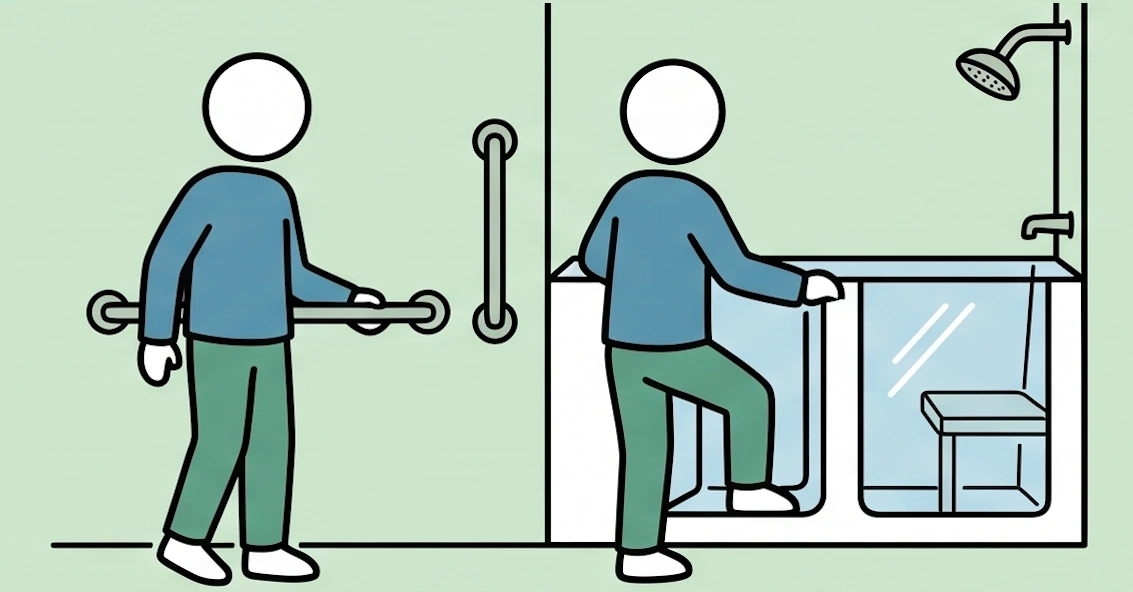
Slip resistant flooring alone is not enough to provide complete protection for seniors. This is because seniors face extreme lack of mobility, which restricts them from using other bathroom elements.
Installing grab bars or a shower bench will help them get up and sit down comfortably, preventing them from prolonged standing.
Also, installing walk in bathtubs is a mandatory decor item you should add. In this way, seniors no longer have to lift their feet and can bathe comfortably.
Reduce Fall Risks by Making Stairs Safer
Alongside renovating rooms, bathroom floors, furniture, and lighting, stairs also need to be on your checklist, as most fatal accidents occur due to falling down the stairs.
To keep your stairs safe for elders to use comfortably, make sure they are well lit (sensor lights work best). Apart from this, install handrails (on both sides if possible) so that they can have support while walking up and down the stairs.
Also, you can install stairlifts to easily navigate stairs without any accidents.
Access Essential Caregiver Support for Aging Adults
To know how to age in place, older adults need to understand caregiver services and what facilities they offer.
Formal home care and caregiver support services are mainly organized at the provincial and territorial levels, supported by federal policy frameworks and even non profit community organizations.
Primary In-Home Services and Facilities
It can be broadly divided into home healthcare, delivered by daily health professionals, and personal support services delivered by home health aides.
Here, the caregivers take complete care of senior adults, assisting them to do basic daily activities, offering nursing and clinical care, and therapy and rehabilitation.
Non-Profit and Community Visiting Care Networks
These organizations provide home care and community support, which help seniors to be independent and safe in their own living place.
There are many organizations that constantly work towards protecting, educating, and advocating for the rights of older adults across Canada. Also, there are institutions that offer 24/7 mental health and emotional support services to Canadian seniors.
Government-Funded Provincial Home Care Programs
Every province and territory manages government aided caregiving services at home for seniors.
To regulate public programs such as Ontario Health, Vancouver Coastal Health, and Alberta Health Services, a case manager is recruited who mainly arranges home visits based on the personal and clinical requirements of the senior.
Know When Aging in Place Is No Longer the Best Option
Aging in place is a promising option for seniors in Canada with varied care facilities and financial assistance. But in some extreme cases, it is required that you move to a care facility where you are under 24/7 clinical monitoring.
- Extreme health decline
- Frequent falls and growing unsteadiness
- Increasing rate of isolation leading to stress, anxiety, and loneliness
- Caregiver burnout due to 24/7 service at home
Most Canadian seniors want to stay in their own places as long as it's possible. Naturally, aging in place has become one of the most preferred options for them.
Access to services, healthcare, and financial support enables seniors to live independently in their own homes. So, instead of moving into a new caregiving facility, seniors should make their living places safer and more secure to live happily and independently.
Disclaimer:
The information provided in this guide is for educational and informational purposes only. While government programs such as the Old Age Security (OAS), Guaranteed Income Supplement (GIS), and various provincial housing and health benefits are designed to assist Canadian seniors, specific funding amounts, estimated living costs (such as the $900–$3,500 monthly home expenses or $4,000–$7,000 assisted living costs), and eligibility criteria are subject to change. Always consult with a qualified financial planner, healthcare provider, or designated provincial case manager before making definitive decisions regarding home renovations, healthcare technology adoption, or long-term care plans.
Sources:
1. https://seasonsretirement.com/financial-assistance-options-for-senior-living-in-canada-what-you-need-to-know/
2. https://www.uclahealth.org/news/article/aging-place-technology-making-it-easier-stay-home
3. https://www.comforcare.ca/blog/why-aging-in-place-is-so-important-for-seniors_ae291/
4. https://ontariohealthathome.ca/above-and-beyond-caregiver-recognition-program/resources-for-caregivers/


 Get Help With The Push Of A Button