

8 Best Core Exercises For Seniors (Safe, Low Impact)
Strengthening core muscles is essential as it boosts balance and stability among seniors. For older people, being active isn't a matter of fitness only; it is a matter of reducing the risk of falling and enhancing posture and mobility. Hence, core training is a great method to make the back and abdominal muscles stronger, since all body movements are linked with the core muscle groups. As you begin to do the exercises, you also support and stabilize your spine, which helps you bend, reach for something on the floor or over your head, and twist without too much difficulty. But before starting a new exercise routine, talk to your doctor to avoid any unnecessary injuries. It is important to be aware of any muscle or joint restrictions, cardiovascular concerns, or other physical conditions.
Our Key Takeaway
To improve body stability and flexibility, older adults need to practice core training workouts regularly.
- Low impact core exercises are ideal for seniors to strengthen their abdominal, lower, and upper body muscles.
- A 10 minute workout session weekly is enough for seniors.
- Increase your workout regimen level after consulting with a doctor.

Life Assure Product Quiz
Take our 30 second quiz and discover which Life Assure medical alert device is the right fit for you or a loved one.

Life Assure Product Quiz
Take our 30 second quiz and discover which Life Assure medical alert device is the right fit for you or a loved one.

Why does core strength matter for seniors?
First, it is important to understand that core muscles are not the same as abdominal muscles. They include all the muscles in the trunk and pelvis, including the lower back, the obliques, and the pelvic floor. As a person ages, core muscles become weaker, posture changes, balance becomes unstable, and back pain increases. Core exercises strengthen all these muscles and work together for the overall well-being of elderly people.
Preventing falls and gaining stability
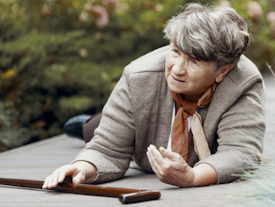
Accidental falls are one of the main reasons for injuries among seniors; these lead to fractures, frequent hospitalization, and loss of mobility. A strong core is the foundation or anchor for the rest of the body to stand on, support muscles, and prevent falls. They develop dynamic balance, physical stability, correct posture, and mobility. Core strength exercises support the development of muscles and good spine health, minimizing the chances of becoming injured in normal tasks like bending, picking up, and twisting.
Improved Functional Movement
Core muscles lie in the middle of the body and work to coordinate the upper and lower body. Hence, good core stability is important and fundamental in controlling regular functional movements like walking, climbing up and down the stairs, getting in and out of bed, couches, or chairs, and also in recreational activities. Therefore, incorporating core strength exercises in a daily workout routine is mandatory for aging adults.
Pain Prevention and Reduction
Poor posture and severe backaches are common ailments of most older people due to weak core muscles. As people get older, spinal disc wear, arthritis, and diminished posture occur more frequently. Since the core muscles are weak, excessive weight is borne on the lumbar spine and impacts you during normal activities. Core exercises can help improve muscle strength, proper weight distribution, lessen undue stress on the spinal joints, stabilize the vertebrae, and ease back pain.
Helps with coordination
Seniors not only struggle with flexibility and balance, but their coordination capability also faces a major setback. This is because coordination highly depends on a well-functioning core. Flexibility and core muscle strength are required for any twists or turns in the body. Adding core strength exercises to your regular workout routine provides you with a solid foundation and frees up your movement with fewer chances of sprains, strains, and injuries.
8 safe and low-impact core exercises for Seniors
Core muscles are responsible for keeping you steady and upright when other parts of your body are moving. Some of the exercises below are isometric, which means no involvement of joint movements while the core muscles contract. In addition, the exercises are important for older people who begin to have some balance issues and wish to enhance their balance to reduce the risk of falling. Start your core exercises gym or home routine with 3 days every week; if comfortable, slowly shift to 10 minute daily sessions 7 days a week.
Woodpecker (3 reps, 2 sets)
It is an ideal low impact exercise that mainly helps coordinate the upper and lower body function so that the body becomes stable and strong in the core region. Practicing this isometric exercise helps seniors to do certain tasks easily, such as picking something lightweight from the floor or safely reaching for objects on higher shelves.
- First, stand straight and keep your legs wide apart. Make sure you are comfortable while stretching your legs.
- Then, gradually keep one leg in front and slightly bend it, and keep both your back and leg straight.
- Then, lean your chest forward and lift your hands over your head
- Maintain this position to improve your balance.
- While doing the exercise, normally keep count of your breaths.
Seated Tabletop Press (5 reps, 3 sets)
It is one of the convenient abdominal exercises for seniors as it can be performed at any time you are sitting on a chair or desk. This exercise primarily focuses on strengthening the rectus abdominis (the front of your abdomen), which actively takes part in helping older adults to get up comfortably from the floor, couch, or bed.
- Sit on a sturdy chair in front of the table and keep your hands straight to the front over the table, palms facing downwards.
- Slowly push your hands down to the table.
- While doing so, squeeze your abdominal muscles while you continue to push down your palms on the table.
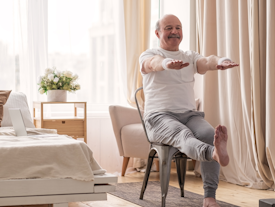
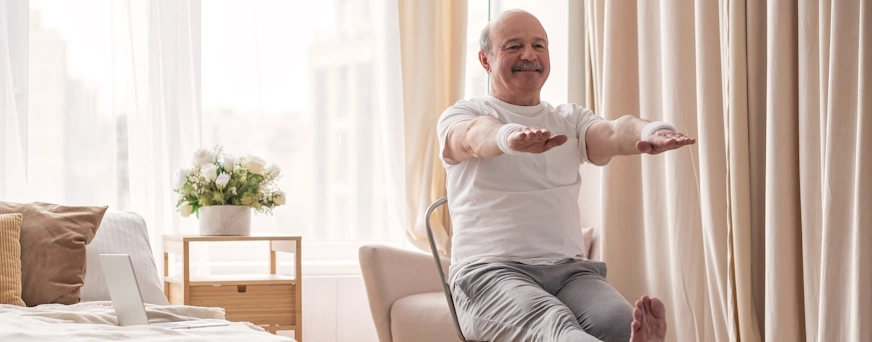
Core Balance Squat (3 reps, 2 sets)
The main function of your core is to keep you balanced. Therefore, workouts which aim at improving your balance and stability increase the workload on your core muscles. In this exercise, you are not just trying to maintain a proper position, but also balancing your whole body on one leg. Therefore, strengthening your core muscles will make them more stable. Practicing these exercises will build your confidence and also prevent you from falling on uneven surfaces such as rocky pavements or narrow sidewalks.
- Stand straight on the floor without any support from a chair or wall.
- Then keep your legs about shoulder width apart.
- Raise both hands and extend them wide open, which will help you to remain steady.
- Then slowly lift one foot off the ground behind you, and lean your chest forward.
- After that, slightly bend your knee into a squat position
- While doing this, if you feel pain in your knee or calf, or anywhere else, stop immediately and rest for a while.
Seated Dead Bug (5 reps, 3 sets)
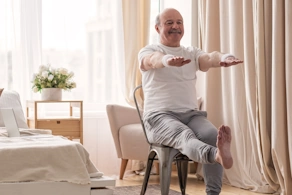
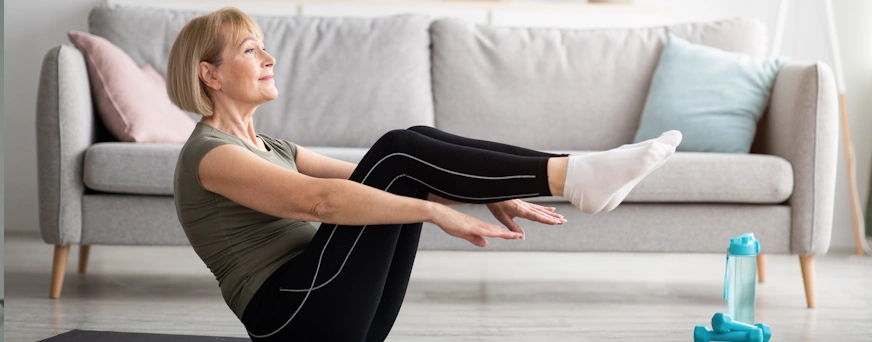
It is one of the most significant abdominal exercises for seniors, which strengthens core muscles (both upper and lower). To do this exercise, you have to sit on a strong chair so that you can lean back comfortably, keeping your back in an upright position and arms out. After that, follow these directions.
- After making yourself comfortable on the chair, keep your head up, squeeze your core muscles, and raise your right hand up and left leg out simultaneously.
- Hold this position for a second.
- Then come back to the normal position
- Repeat these steps with the other legs and hands.
Pall of Press (8 reps, 2 sets)
Another notable function of your core is rotation. This advanced level isometric exercise targets rotational muscles such as obliques around your torso. This improves your posture and spinal health. This helps you gain flexibility in doing activities that require twists and turns, such as playing pickleball or doing laundry or dishwashing.
- Tie a light resistance band around your doorknob and stand sideways.
- While keeping hip width distance between legs, stand a few steps away from the closed door so that it opens away from you, not on your face.
- Make sure you are comfortable; do not overexert while pulling the band
- Then hold the ends of the band and stretch your hands to the front away from your belly.
- Stay in this position for a few seconds, then come back to the original position.
Side Plank on Wall (5 reps, 3 sets)
It is the same as the plank on table exercise, just you have to do the exercise against the wall and in a standing position. This core training exercise strengthens your core muscles throughout the upper and lower body. When you balance your body on one arm, this helps improve the strength capacity of the muscles on one side of your trunk. These muscles help in rotational movements or grabbing stuff from both higher and lower shelves.
- First, stand sideways to the wall and place your forearm on the wall at shoulder height.
- Then step away from the wall, placing more weight on your forearm.
- While you maintain this position, squeeze your core muscles
- After 3 seconds, then come back to the original position.
Leg Lifts (6 reps, 3 sets)
For simultaneous strengthening of the abdominal and oblique muscles, leg lifts are a perfect way out. You can do them seated or in a lying position; the choice is up to your comfort level.
- If you prefer lying on the floor, then lie flat on your back, keep your whole body straight, and keep your hands on the sides.
- If you are sitting on the chair, then place your legs straight on the surface, slightly bending your knees.
- Then raise one leg upward as high as you can, which will keep pressure on the core without making any changes to the position of the other leg.
- While lying down, raise your leg above five inches from the floor.
- While maintaining both of these positions, keep your back straight.
- Stay in this position for around 3 seconds.
- After that, come back to your original position and repeat with the other leg.
Seated Side Bends (10 reps, 3 sets)
All core or abdominal exercises for seniors, including seated side bends, can be modified as per individual capacity. In the beginning, you may start with a sturdy chair, but then strengthen your core muscles by replacing sitting on the chair with lying on the floor. However, this exercise will not only work on abdominal muscles but also on the external and internal obliques.
- After positioning yourself on the chair, slowly bend your knees and place your feet flat on the ground.
- Then keep the palm of your right hand on the back of your head.
- After that, position your right elbow in a way that it runs parallel to your right ear.
- While you maintain this posture, your left hand needs to be hanging straight beside your side.
- Make sure you keep your body straight to avoid slouching your back
- Breathe in and out slowly, and while you are exhaling, slightly bend to the left side and bring your left arm close to the floor.
- After that, pull back your right elbow, which will cause a stretch on the side, strengthening your core.
- At any point, if you feel uncomfortable, then go back to the normal position without overexerting yourself.
- Breathe normally and come back to the original position.
Key Progression Dimensions of Core Exercises for Seniors
Progressing your workout routine helps in improving body movements, base of support, and posture, while strengthening the spine and trunk safely. Therefore, when you start at the beginner level, with daily practice you can move to the intermediate and advanced level, improving your capacity to the top level. Slow and steady core training progression helps in gaining better stability and flexibility.
Primary Level
If you have just started your core exercises gym or at home, then focus on the three major elements: in depth abdominal muscle stretching, controlled breathing, and spinal alignment. First of all, always use a chair while doing the exercises. Here, the motion range is short but with strict control. Hold exercise positions for 3 to 5 seconds with no additional pressure on spinal extension. Modified wall and table planks, and abdominal draws are some exercises that you can perform at this level. The primary objective here is to engage in stabilizing abdominal muscles while you maintain steady breathing.
Intermediate Level
You've been doing a core exercises gym or home routine for a while, and now it is time to boost the level of your exercises. Move from seated to standing positions using a wall, door, or resistance bands for support. Side plank to wall and Pallof press work the abs and will make doing strenuous chores easier. Hold each positions in these exercises for 10-15 seconds rather than 3-5 seconds. With this level of training, core exercises are combined with hip and shoulder movements to stabilize the trunk muscles. Some exercises can also be performed with resistance bands.
Advanced Level
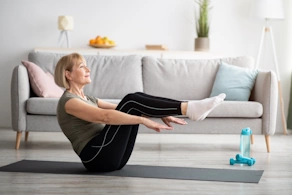
Advanced core training exercises are a high level full body workout regimen. When you have surpassed both these levels, then your body has attained the stable stage where you can perform exercises without external support from the chair or wall. To build more strength, practice exercises such as seated dead bugs or leg lifts without the support of a chair. Steps would be similar, but you would sit on the floor, which will put more strain on the core muscles and strengthen them, speeding the whole process. You can also lie down on your back on the ground and move your arms and legs. Now hold the positions for around 30 seconds or more, and do more repetitions than in the previous stage. Therefore, an advanced workout routine ensures your body’s mobility does not get compromised during activities. At this level, the exercises are aimed at preparing your body to handle real time activities such as balancing yourself when you accidentally trip on the floor or lifting any items.
10 minute core exercise routine for seniors
Follow this low-impact, safe 10 minute core training exercise routine at least 2 to 3 times a week, if not regularly.
Warm up (1minute)
Prepare your body for a consistent workout with some arm and leg stretches along with hip twists and turns.
Seated Exercises (3 minutes)
First, start with seated exercises and wrap it up in under 3 minutes. For around 60 seconds practise each exercise. However, if you have difficulty doing these exercises, then take a pause.
Standing exercises (3 minutes)
Take a few seconds' rest, then perform wall planks and side bends while maintaining an upright position. For support, you can use a chair.
Floor exercises (2 minutes)
Lie down on a soft yoga mat and practice exercises such as Dead Bug and leg lifts, improving your lower back support and rotational stability.
Rest (1 minute)
Take normal breaths and, for around 60 seconds, sit still either on the chair or on the floor.
Safety precautions for seniors while doing core exercises
For exercises to be effective, they need to be executed properly. Here are some safety tips that you can follow while doing core training exercises.
- Choose a proper place with no hindrances so that you can move safely
- Wear light clothes and comfortable shoes to avoid discomfort
- Start your exercises with easy and simple exercises
- Breathe normally; do not hold your breath while doing exercises.
Core training workouts improve your functional ability by building your mobility and flexibility. To develop core muscles, you need to follow a consistent weekly exercise routine without interruptions. Here, several types of core exercises are discussed that you can alternate in your routine. For example, if you feel pain in your abdominal muscles, then practice exercises that build up your back muscles.
Sources:
1. https://www.racmn.com/blog/the-importance-of-balance-and-core-strength-for-senior-fitness
2. https://www.health.harvard.edu/healthy-aging-and-longevity/the-best-core-exercises-for-older-adults
3. https://www.hingehealth.com/resources/articles/core-exercises-for-seniors/
Disclaimer:
Always consult with a doctor before beginning any new exercise regimen. To prevent injuries and preserve long-term health, it is essential to start slowly using low-resistance bands and light dumbbells. Consistent, steady progression should be prioritized over lifting heavy weights as you build a comfortable, at-home strength routine. Furthermore, individuals with osteoporosis need to take special care to lift weights quickly while ensuring they lower the weight slowly and with strict control.

 Get Help With The Push Of A Button